San Ysidro Border Crossing Guide: Wait Times, Tips & Best Hours (2026)
March 25, 2026
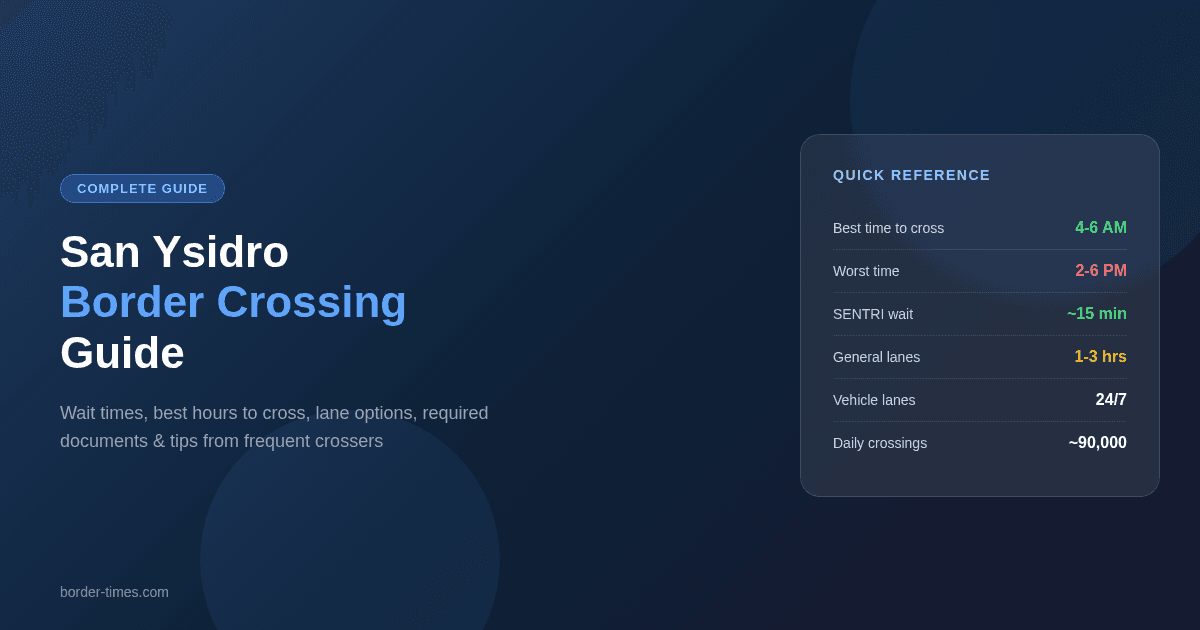
San Ysidro is the busiest land border crossing in the Western Hemisphere, ranked #1 by the Bureau of Transportation Statistics (source: bts.gov) with an average of 87,569 daily crossings — including approximately 41,700 personal vehicles and 19,500 pedestrians per day (2.7 million crossings per month). Located where San Diego meets Tijuana, this port of entry is a lifeline for daily commuters, weekend visitors, and international travelers alike. Whether you cross every day or this is your first time, knowing when to go, which lane to use, and what documents to bring can save you hours. This guide covers everything you need to know about crossing at San Ysidro, backed by Border Times historical data and government statistics.
San Ysidro at a Glance
Here are the key facts about the San Ysidro Port of Entry:
- Location: San Ysidro, California — the southernmost neighborhood of San Diego, directly adjacent to Tijuana, Baja California
- Vehicle lanes: Open 24 hours a day, 7 days a week
- Pedestrian crossing (PedEast): Open 24 hours a day
- Pedestrian crossing (PedWest): Currently operating on limited hours — northbound 6:00 AM to 2:00 PM, southbound 3:00 PM to 11:00 PM. Check CBP’s website (cbp.gov) or call (619) 690-8999 for the latest PedWest status, as hours have changed multiple times since 2023
- 34 northbound vehicle inspection lanes with 62 inspection booths (after the 2019 expansion)
- Average of 87,569 daily crossings in both directions (source: Bureau of Transportation Statistics, bts.gov)
- One of three San Diego–Tijuana area ports of entry, along with Otay Mesa and Cross Border Xpress (CBX)
Current Wait Times
Wait times at San Ysidro are reported by CBP (Customs and Border Protection) and updated approximately every hour. CBP tracks wait times separately for each lane type: standard vehicle lanes, SENTRI lanes, Ready Lanes, and pedestrian crossings. You can check official CBP wait times at bwt.cbp.gov or by calling (619) 690-8999.
Border Times goes beyond official CBP data by combining it with crowdsourced reports from people actually in line and GPS-based trip tracking. This gives you a more accurate, real-time picture of actual conditions at each lane type. Download the Border Times app for iOS or Android to get live wait times, community reports, and push notifications for your favorite ports.
Best Times to Cross at San Ysidro
Timing is everything at San Ysidro. The difference between arriving at the right hour and the wrong one can mean saving two or more hours of waiting. The charts below compare all three vehicle lane types — Standard, Ready Lane, and SENTRI — so you can see exactly how much each one saves.
San Ysidro — Sunday: All 3 Lane Types Compared
Average wait by hour and lane type — Border Times historical data (PeakHoursCache)
San Ysidro — Daily Average Wait: Standard vs. Ready Lane vs. SENTRI
All-hours average by lane type — Border Times historical data (PeakHoursCache)
The table below breaks down standard vehicle lane wait times by time of day, with Ready Lane and SENTRI comparisons. These are averages across all days of the week from Border Times historical data (PeakHoursCache).
| Time Window | Standard Lane | Ready Lane | SENTRI |
|---|---|---|---|
| 3:00 – 7:00 AM | 15–30 min | 15–30 min | 5–10 min |
| 7:00 – 10:00 AM | 30–110 min | 30–100 min | 5–20 min |
| 10:00 AM – 12:00 PM | 53–173 min | 41–130 min | 11–23 min |
| 12:00 – 3:00 PM | 73–170 min | 50–140 min | 15–20 min |
| 3:00 – 7:00 PM | 60–175 min | 45–150 min | 10–25 min |
| 8:00 – 11:00 PM | 28–155 min | 15–145 min | 5–15 min |
Day-of-week patterns also make a significant difference. The table below shows averages for all three lane types, so you can plan around both the best day and the best lane for your situation.
| Day | Standard Lane | Ready Lane | SENTRI | Best Window (Std.) |
|---|---|---|---|---|
| Sunday | 92 min | 75 min | 15 min | 3–7 AM (15–30 min) |
| Monday | 88 min | 69 min | 14 min | 9–11 PM (48–65 min) |
| Tuesday | 73 min | 54 min | 12 min | 10–11 PM (21–25 min) |
| Wednesday | 62 min | 43 min | 11 min | 12–2 AM (15–16 min) |
| Thursday | 68 min | 53 min | 12 min | 12–2 AM (15–26 min) |
| Friday | 76 min | 56 min | 13 min | 1–2 AM (18–20 min) |
| Saturday | 107 min | 87 min | 15 min | 3–4 AM (15–20 min) |
Crossing Options: Which Lane Should You Use?
San Ysidro offers several types of northbound crossing lanes. Choosing the right one can dramatically reduce your wait — as the charts above show, the gap between Standard and SENTRI can be over two hours during peak times.
Standard Vehicle Lanes (General)
Standard lanes are open to all travelers with valid documents and require no pre-enrollment — just a valid passport or accepted travel document. These lanes see the longest waits, averaging 62–107 minutes depending on the day of the week, with peaks reaching 174 minutes on Sunday afternoons.
Standard lanes handle approximately 14% of total vehicle crossings at San Ysidro. If you’re crossing for the first time or don’t have an RFID-enabled document, this is your lane.
SENTRI Lanes (Trusted Traveler)
SENTRI (Secure Electronic Network for Travelers’ Rapid Inspection) is a CBP trusted traveler program that gives you access to dedicated express lanes. Based on Border Times historical data, SENTRI lane waits average just 11–15 minutes on any day of the week and rarely exceed 30 minutes even during peak hours.
Enrollment requires a background check, an interview at a CBP enrollment center, and a fee of $120.50 for five years (source: cbp.gov/travel/trusted-traveler-programs/sentri). SENTRI members also get access to Ready Lanes and TSA PreCheck, making it particularly worthwhile for frequent crossers. SENTRI lanes process approximately 42% of all San Ysidro vehicle crossings.
Ready Lanes
Ready Lanes are for travelers with RFID-enabled documents: a U.S. Passport Card ($65 for adults, valid 10 years — source: travel.state.gov), SENTRI card, permanent resident card (green card), or Border Crossing Card (BCC / Laser Visa).
Ready Lane waits fall between Standard and SENTRI, typically saving 15–35 minutes versus the standard lane. Based on Border Times data, Ready Lane daily averages range from 43 minutes (Wednesday) to 87 minutes (Saturday). Ready Lanes process approximately 44% of all San Ysidro vehicle crossings. No separate enrollment is needed — just have the right document.
Pedestrian Crossing — PedEast (Historic Customs House)
PedEast is open 24 hours a day and offers SENTRI, Ready Lane, and general pedestrian lanes. Typical pedestrian waits range from 30 minutes to 1.5 hours depending on the time of day. Note that I-94 permits are NOT issued at PedEast — go to PedWest if you need one.
Pedestrian Crossing — PedWest
PedWest is currently operating on limited hours: northbound 6:00 AM to 2:00 PM, southbound 3:00 PM to 11:00 PM. These hours have changed multiple times since 2023, so always verify before traveling by checking the CBP website (cbp.gov) or calling (619) 690-8999. I-94 permits ARE issued at PedWest, and up to 12 northbound pedestrian booths are available.
| Lane Type | Daily Avg Wait | Enrollment Required? | Best For |
|---|---|---|---|
| Standard Vehicle | 62–107 min | No | Occasional crossers without trusted traveler status |
| SENTRI | 11–15 min | Yes ($120.50 / 5 years) | Frequent crossers, daily commuters |
| Ready Lane | 43–87 min | No (RFID document needed) | Regular crossers with a Passport Card or green card |
| PedEast (24h) | 30–90 min | No | Pedestrians anytime, especially overnight or early morning |
| PedWest (limited hours) | 20–60 min | No | Pedestrians during PedWest operating hours |
Required Documents
The documents you need depend on your citizenship and how you’re crossing. Here’s a summary based on CBP’s Western Hemisphere Travel Initiative (WHTI) requirements for land crossings (source: cbp.gov/travel/us-citizens/western-hemisphere-travel-initiative):
U.S. Citizens
- U.S. Passport (book) — accepted at all lanes
- U.S. Passport Card — valid for land and sea crossings only (not air travel); works in Ready Lanes. Cost: $65 adults, $50 minors (source: travel.state.gov)
- Enhanced Driver’s License (EDL) — issued by certain states; valid for land/sea crossings
- SENTRI or NEXUS card — if enrolled in trusted traveler programs
- U.S. Military ID with official travel orders
Mexican Citizens
- Valid Mexican passport with a U.S. visa (if required based on visa category)
- Border Crossing Card (BCC / Laser Visa) — allows entry into the U.S. border zone
- FMM tourist permit if traveling beyond the border zone into Mexico’s interior
Other Nationalities
- Valid passport from your country of citizenship
- Appropriate U.S. visa for your travel purpose
- Mexican visa or FMM permit if entering Mexico (requirements vary by nationality)
- Check with both U.S. and Mexican consulates for specific requirements
Children and Minors
- Children under 16: birth certificate or other proof of U.S. citizenship (original or certified copy)
- Children under 19 traveling with school, religious, or youth groups: birth certificate or citizenship proof
- Minors traveling without both parents should carry a notarized letter of consent from the absent parent(s)
- Mexican law requires additional documentation for minors leaving Mexico without both parents
Getting to San Ysidro
San Ysidro is well-connected by freeway, transit, and nearby alternatives:
By Car
- From central San Diego: Take I-5 South directly to the San Ysidro port of entry (approximately 20 miles, 25–40 minutes without traffic)
- From East County San Diego: I-805 South connects to I-5 South near the border
- Parking: Several paid lots are available near the port, ranging from $8–20/day. Many crossers park on the U.S. side and walk across to avoid vehicle wait times
By Trolley (San Diego MTS)
- The Blue Line trolley runs from downtown San Diego to the San Ysidro Transit Center — the last stop on the line
- The trolley station is a short walk from the PedWest pedestrian crossing
- Runs approximately every 15 minutes; the ride from downtown takes about 40 minutes
- A convenient option to avoid vehicle queues entirely — take the trolley and walk across
Cross Border Xpress (CBX)
- If you’re flying out of Tijuana International Airport (TIJ), the CBX pedestrian bridge connects directly from Otay Mesa, CA to the airport terminal
- CBX is not at San Ysidro — it’s located about 10 miles east in Otay Mesa
- Requires a confirmed airline ticket departing from or arriving at TIJ
- A useful alternative for travelers whose destination is the Tijuana airport rather than Tijuana itself
Tips from Frequent Crossers
- Check Border Times before you leave home — real-time wait data for each lane type helps you decide when to go and which lane to use
- Have your documents ready and easily accessible before you reach the inspection booth
- Know which lane you’re eligible for before arriving — SENTRI, Ready Lane, or Standard
- Avoid peak hours: standard lane waits are worst on Monday mornings (180 min at 7–8 AM) and Sunday afternoons (170+ min from 4–6 PM). Saturdays peak in the evening at 160+ min from 5–7 PM
- Consider walking across when standard vehicle waits exceed 2 hours — pedestrian lines are often significantly shorter
- If you cross regularly, a SENTRI enrollment ($120.50 for 5 years — source: cbp.gov) or even a U.S. Passport Card ($65 — source: travel.state.gov) for Ready Lane access pays for itself quickly in time saved
- Bring water and snacks for longer waits, especially if traveling with children
- Know food restrictions: fresh fruits, vegetables, and meats are generally prohibited when entering the U.S.
- Fill your gas tank before getting in line — idling in a long queue burns fuel
- Use restrooms before entering the vehicle queue — there are limited facilities once you’re in line
- If San Ysidro standard lane waits are extreme, check Otay Mesa as an alternative (about 10 miles east)
What to Know About Tijuana
Tijuana is one of the most visited cities in the world, welcoming millions of crossers each year. From the famous Avenida Revolución to a thriving food and craft beer scene, there’s plenty to explore just south of the border.
- Currency: Mexican Peso (MXN). Many tourist-area businesses accept U.S. dollars, but you’ll get better value using pesos. Currency exchange houses (casas de cambio) are available on both sides of the border
- Safety: Stick to well-traveled tourist areas, especially if it’s your first visit. Zona Centro, Zona Río, and Playas de Tijuana are popular and well-patrolled areas
- Transportation in Tijuana: Taxis, rideshare apps (Uber, Didi), and local buses (calafias) are widely available
- Auto insurance: If driving into Mexico, your U.S. auto insurance likely does not cover you. Purchase Mexican auto insurance before crossing — it’s available online or at offices near the border
Frequently Asked Questions
Can I walk across the border at San Ysidro?
Yes. San Ysidro has two pedestrian crossings: PedEast (open 24 hours) and PedWest (currently limited hours: northbound 6 AM–2 PM, southbound 3–11 PM). Walking is often faster than driving during peak hours. Many crossers park on the U.S. side, walk into Tijuana, and take a taxi or rideshare to their destination.
How long is the wait at San Ysidro right now?
Wait times change throughout the day and vary significantly by lane type. The standard vehicle lane averages 62–107 minutes depending on the day, while SENTRI averages just 11–15 minutes. Check the Border Times app for real-time data that combines CBP wait times with crowdsourced reports from people in line. You can also check bwt.cbp.gov for official CBP wait times, updated approximately every hour.
Is SENTRI worth it?
For frequent crossers, almost certainly yes. SENTRI costs $120.50 for five years (source: cbp.gov) and gives you access to dedicated lanes where the average wait is just 11–15 minutes — compared to 62–107 minutes in the standard lane. SENTRI lanes handle approximately 42% of all San Ysidro vehicle crossings. You also get Ready Lane access and TSA PreCheck.
Can I bring food across the border?
Going northbound into the U.S., there are strict restrictions. Fresh fruits, vegetables, and most meats are generally prohibited. Commercially packaged foods are usually allowed. CBP officers may inspect your vehicle or bags. Going southbound into Mexico, restrictions are less strict, but large commercial quantities may require a customs declaration.
What time does the pedestrian crossing open?
PedEast is open 24 hours. PedWest is currently operating on limited hours (northbound 6 AM–2 PM, southbound 3–11 PM), but these hours have changed multiple times. Always check the CBP website (cbp.gov) or call (619) 690-8999 before traveling to confirm PedWest’s current schedule.
What’s the difference between San Ysidro and Otay Mesa?
Both connect San Diego and Tijuana, but they’re about 10 miles apart. San Ysidro is the larger, busier port with both vehicle and pedestrian crossings. Otay Mesa is primarily a commercial port but also handles passenger vehicles and tends to have shorter waits during peak times. San Ysidro has trolley access; Otay Mesa does not.
Wait time data from Border Times historical averages (PeakHoursCache-prod, verified 2026-03-25). Crossing volume data from the Bureau of Transportation Statistics (bts.gov). SENTRI fee from cbp.gov. Passport Card fee from travel.state.gov. Actual wait times vary by day, season, and conditions.
Ready to cross smarter?
Download Border Times — free on iOS, Android, and web.